
- October 26, 2026
Author: Tanya Khurana, Marketing and Communications Officer, Oxford Pharmacy Store.
Updated for the 2026 implementation, commercial and logistics phase
Standardisation is no longer an emerging concept in NHS aseptic medicines. The foundations have been built through national dose banding, common product specifications, stability work, digital identification and an increasingly clear direction towards the use of ready-to-administer medicines where appropriate.
The question for the next phase is different: how can these foundations be converted into dependable supply and usable capacity?
Capacity is not created simply by publishing a specification but when organisations adopt common products, demand becomes visible and predictable, manufacturers can produce at meaningful scale, and medicines can be held and distributed reliably.
The NHS Infusions and Special Medicines Programme formally closed on 30 September 2026. Its closure did not mark the end of aseptic transformation. Rather, it reflected a transition from developing national enablers towards embedding them in routine practice, commercial arrangements and future supply models.
The challenge is now to turn consistency into capacity, and capacity into dependable patient access.
The foundations are now in place
National chemotherapy dose banding was introduced in 2016, followed by work to develop common specifications for medicines prepared by NHS aseptic units and licensed manufacturers.
In 2020, Lord Carter’s review of NHS pharmacy aseptic services described an opportunity to reduce unwarranted variation, modernise infrastructure and redesign production through a more coordinated system. Its ambition was to protect local specialist capacity for bespoke medicines while producing suitable standardised products at greater scale.

Since then, national work has developed the components needed to define a standard aseptic product more consistently. These include:
- agreed dose or concentration;
- presentation and fill volume;
- diluent and container;
- expiry and storage conditions;
- standardised naming and labelling;
- stability evidence;
- digital identification through the NHS dictionary of medicines and devices, or dm+d; and
- a governed process for authoring, reviewing, approving and updating specifications.
The national product-standardisation work initiated under the NHS Infusions and Special Medicines Programme reinforced an important principle: a standard product is more than a standard dose. It requires sufficient alignment across prescribing, procurement, manufacture, distribution and administration to create a recognisable product identity throughout the supply chain.
This does not mean imposing uniformity where clinical or technical differences are necessary. Patient-specific medicines, advanced therapy medicinal products, clinical trial medicines, complex preparations and products with very short shelf lives will continue to require specialist facilities and expertise.
The purpose of standardisation is to protect that expertise by reducing avoidable variation in products that can safely and appropriately be prepared at scale.
The challenge has changed
The NHS is no longer starting from the position described in 2020.
The 2026 review of aseptic services recognised that demand and treatment complexity have continued to grow while services face ongoing operational pressures, including workforce constraints and ageing facilities. It identified standardisation, productivity improvement, commercial agility, stronger NHS-industry relationships and effective logistics as important elements of future development.
The strategic question has therefore moved on from whether aseptic services need to transform. It is now about how the NHS sustains and scales the transformation already under way.
This distinction matters.
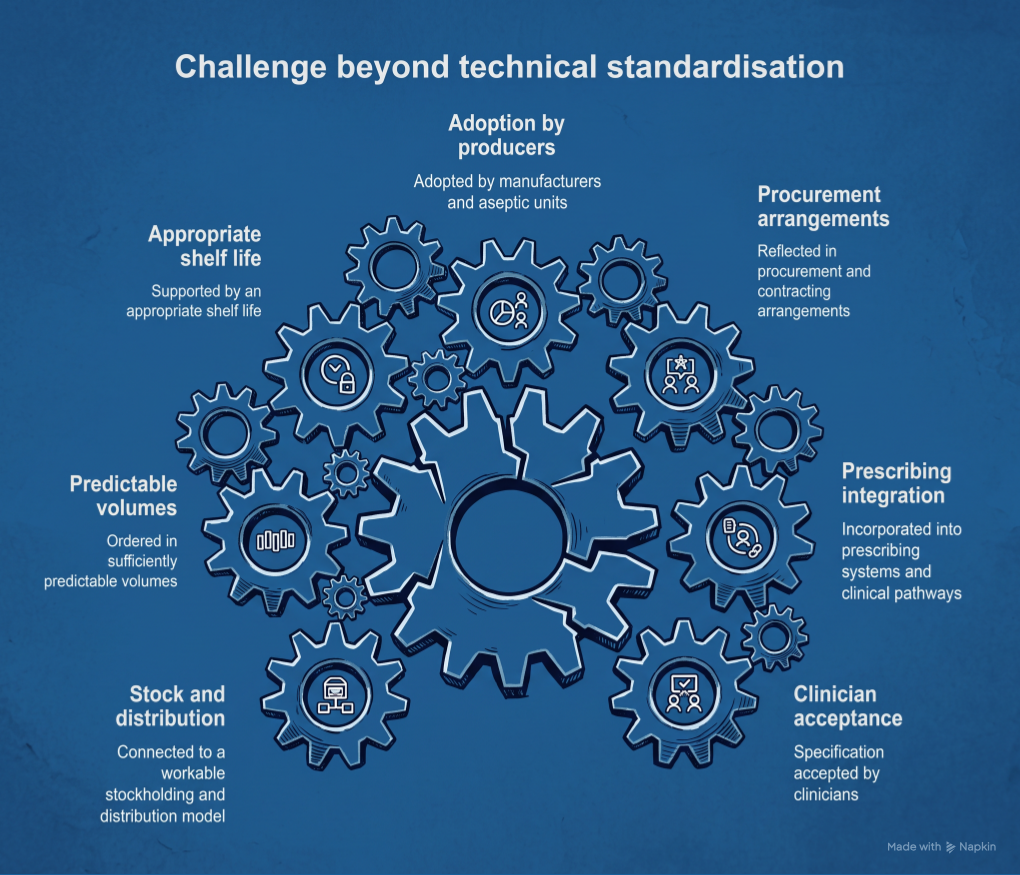
National specifications create the possibility of scale, but they do not produce scale automatically. A specification only begins to release capacity when it is:
• accepted by clinicians;
• incorporated into prescribing systems and clinical pathways;
• reflected in procurement and contracting arrangements;
• adopted by manufacturers and aseptic units;
• supported by an appropriate shelf life;
• ordered in sufficiently predictable volumes; and
• connected to a workable stockholding and distribution model.
The principal challenge is therefore no longer technical standardisation alone.
It is coordinated implementation.
Standardisation only works when products are adopted
Local variation is rarely arbitrary. Trusts have developed prescribing systems, clinical pathways, procurement arrangements, nursing practices and product preferences over many years. These arrangements may also reflect local specialties, available facilities, compounding capacity, workforce constraints and previous experience of supply.
Moving to a common product can therefore require changes across several connected systems.
A different infusion volume may affect prescribing records, pump libraries, nursing guidance, storage and local training. A change in labelling or presentation may require amendments to standard operating procedures, worksheets and electronic systems. Procurement teams may need to change catalogue records or contracts, while clinical teams need confidence that the replacement product is safe, suitable and reliably available.
This means adoption cannot be achieved by asking individual trusts to abandon local preferences in isolation. Organisations need:
- clinical and pharmaceutical assurance;
- suitable products in the required presentations;
- sufficient continuity of supply;
- appropriate implementation support;
- compatible digital and prescribing systems;
- workable contractual arrangements; and
- confidence that standardisation will not introduce a new operational risk.
There should remain flexibility where a different product is clinically necessary. However, where several near-identical specifications exist without a meaningful clinical justification, maintaining that variation creates complexity throughout manufacturing, procurement, stockholding and administration.
Reducing such variation is not an end in itself. It is a way of making demand easier to understand and supply easier to organise.
From adoption to a credible market signal
Standardisation can convert fragmented local demand into a clearer collective requirement.
That has consequences beyond production efficiency. When multiple organisations use a consistent product, manufacturers can see a more credible market, undertake investment decisions with greater confidence and plan larger or more regular production runs.
The emerging commercial strategy for aseptic medicines recognises the importance of the future relationship between NHS and independent-sector production. Its scope includes operating models, NHS-industry partnerships, procurement and contracting, investment, risk sharing, resilience and mechanisms to support the adoption of licensed ready-to-administer medicines where these release aseptic capacity and provide overall system value.
The developing model can therefore be understood as a connected sequence:
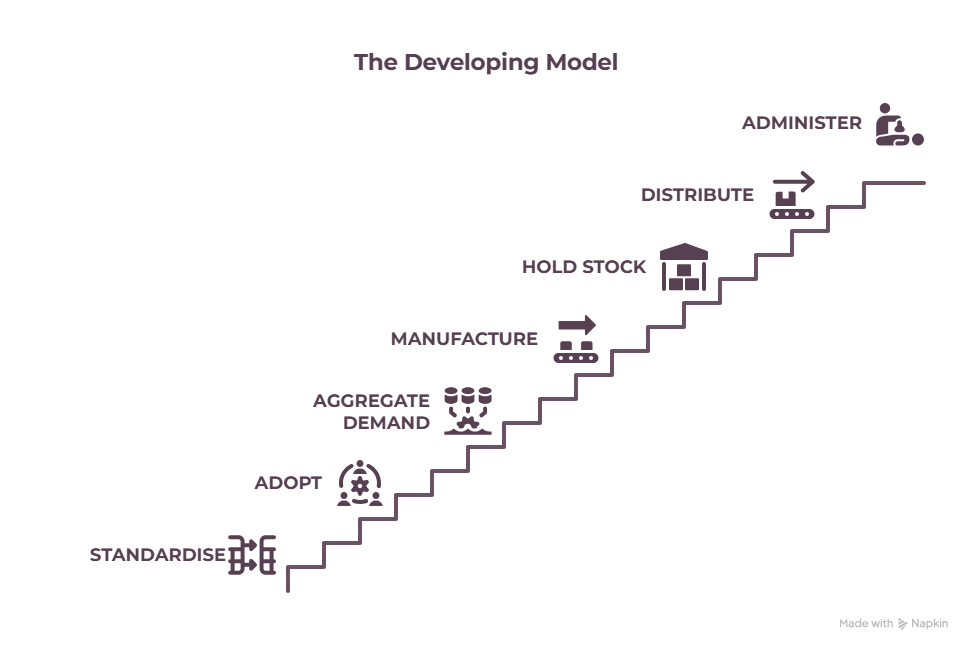
Weakness at any stage limits the benefit of the whole system.
A manufacturer is unlikely to invest in a new presentation solely because a national specification exists. It also needs evidence of likely adoption, credible demand and a workable commercial route to market.
Similarly, a stockholding organisation cannot expand its range simply because a product can be manufactured. It needs sufficient shelf life, reliable forecasts, appropriate quality arrangements and confidence that held stock will be used responsibly.
Common specifications create the basis for a market. Coordinated adoption and dependable demand signals make that market viable.
Manufacturing capacity is only part of the answer
Producing more medicines does not automatically make them available when and where patients need them.
A functional supply model must connect:
- an agreed product specification;
- manufacturing capacity;
- sufficient shelf life;
- demand forecasting;
- procurement and contracting;
- quality assurance;
- stockholding;
- temperature-controlled distribution; and
- communication across participating organisations.
Longer shelf life can enable larger batches and more efficient production, but only where there is sufficient confidence that the stock will be used. Poor forecasting can lead to shortages at one point in the system and avoidable expiry at another.
Reliable forecasting therefore needs to be treated as a shared responsibility. Trusts need to provide realistic demand information and communicate anticipated changes. Manufacturers need to provide visibility of capacity, lead times and production constraints. Stockholders need to monitor stock, expiry and ordering patterns. Procurement and commissioning arrangements must support the intended supply model rather than unintentionally preserve fragmentation.
This becomes particularly important during shortages or unexpected changes in demand. A consistent product identity can make it easier to understand where comparable stock exists and whether mutual support is possible, but standardisation alone does not create resilience. Resilience also depends on communication, contractual flexibility, stock visibility and practical distribution arrangements.
Oxford Pharmacy Store: connecting supply with demand
The Oxford Pharmacy Store off-the-shelf service illustrates how standardisation can be translated into practical availability.
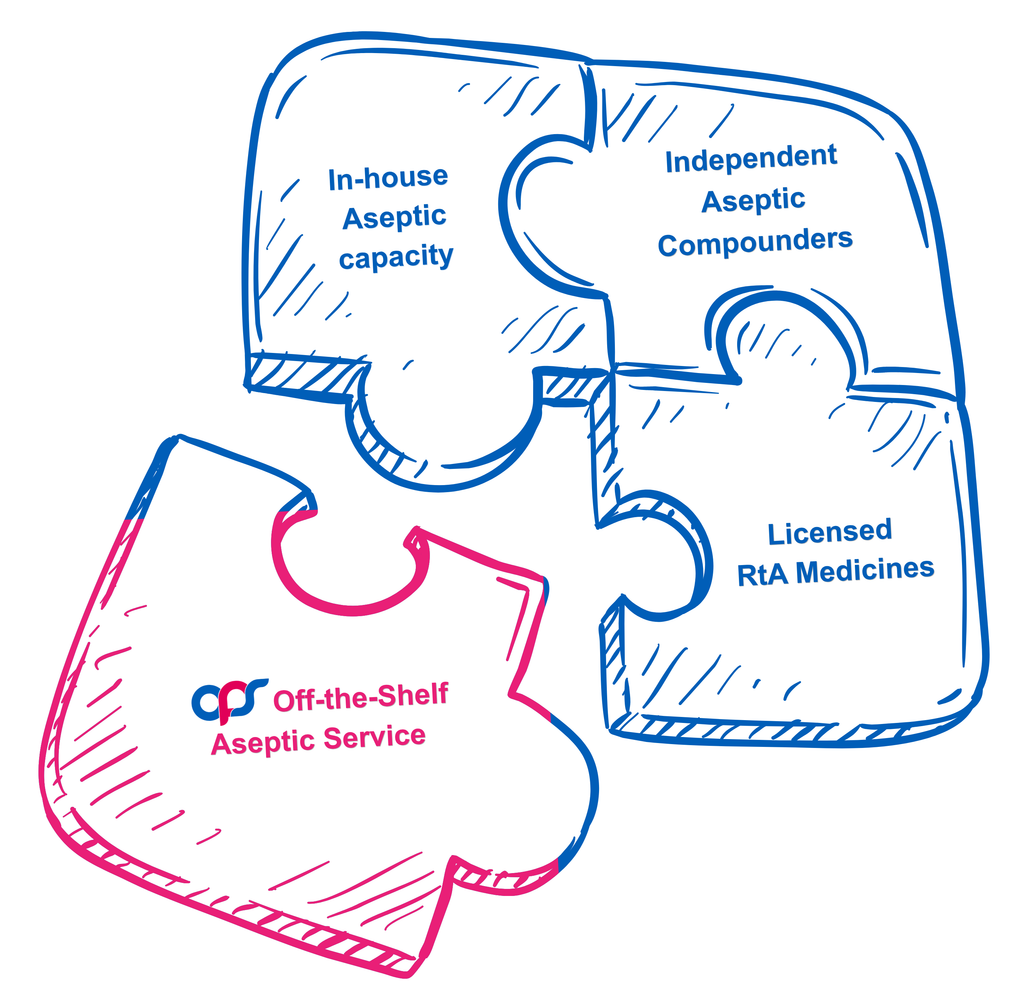
Oxford Pharmacy Store does not manufacture aseptic medicines or determine which products NHS trusts should standardise. Its role is to hold and distribute selected batched products, enabling participating organisations to obtain them through an established stock route where this is clinically appropriate and operationally useful.
The strategic significance of this model is not simply warehouse capacity.
Increasing manufacturing output does not create reliable access unless products can be held, managed and supplied against actual NHS demand. A stockholding model can help connect standardised batch production with day-to-day requirements, turning manufacturing capacity into accessible stock rather than leaving every trust dependent on a separate direct ordering relationship.
The model rests on three linked requirements:
Coordination
Forecasts, available stock, product expiry, ordering, quality information and temperature-controlled delivery need to be aligned. A decision made in one part of this chain affects the others.
Collaboration
Trusts, NHS aseptic units, licensed NHS manufacturers and independent-sector suppliers need to share relevant information and understand their respective responsibilities. A stockholding arrangement cannot compensate for poor demand information or uncommunicated changes in clinical practice.
Clear communication
Changes in demand, availability, specification, delivery arrangements and risk need to be identified early enough for organisations to respond.
Greater adoption of common specifications could strengthen this model. More consistent products would allow trusts to forecast against a shared description, while aggregated demand could support more dependable production and stock planning.
Over time, this could make it more practicable to hold a broader range of appropriate batched products. The intended benefit should be experienced at the point of care through more dependable access, less preparation pressure and greater protection of specialist aseptic capacity.
From national standards to a functioning market
The next phase will require behavioural, operational and commercial change.
Trusts will need to review local exceptions and distinguish genuine clinical requirements from preferences that can safely be aligned. Clinicians and pharmacy teams will need confidence in common products. Digital systems must be capable of identifying and handling them consistently. Procurement and contracting arrangements must support adoption rather than reinforce unnecessary local variation.
Manufacturers will need credible information about future demand. The NHS will need an open and realistic dialogue with both NHS and independent-sector suppliers about investment, capacity, risk, resilience and the practical conditions needed to bring new products to market.
Stockholding and logistics must also be considered at an early stage. These cannot be added after a product has been specified and manufactured. Shelf life, pack configuration, temperature requirements, delivery frequency, minimum order quantities and contingency arrangements all influence whether a product can be supplied effectively.
Implementation should therefore be designed across the whole pathway:
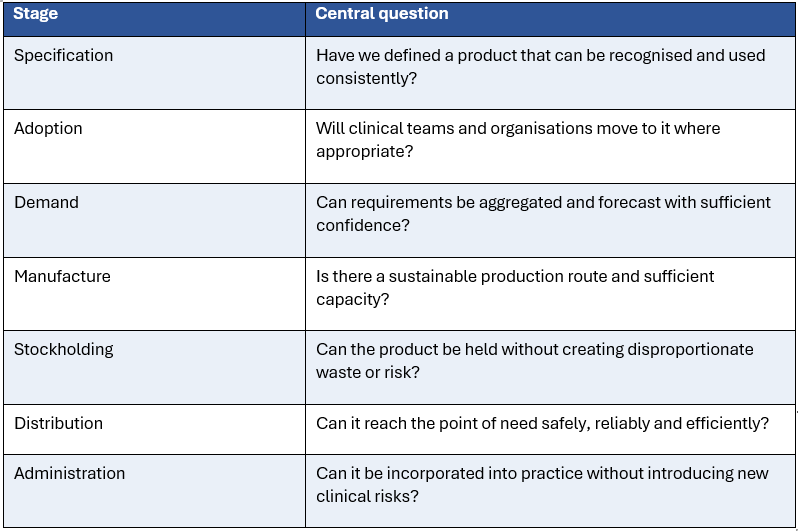
Addressing one stage without the others will deliver only part of the potential benefit.
The next chapter
Standardisation is not the destination. It is an enabler of a more connected model for supplying aseptic medicines.
Common specifications can reduce unnecessary complexity and make demand easier to aggregate. Coordinated adoption can create viable volumes. Reliable forecasts can give manufacturers confidence to produce and stockholders confidence to hold. Appropriate procurement, logistics and distribution can then turn that capacity into dependable access.
The objective is not to eliminate all local preparation or move every medicine into large-scale manufacture. It is to ensure that each product is prepared and supplied through the most appropriate route.
Routine, predictable and longer-shelf-life medicines should increasingly be considered for scalable production and stock supply where this is clinically, operationally and economically justified. Local aseptic services can then focus their specialist capability on bespoke, complex and short-shelf-life medicines that cannot readily be provided through another route.
The next chapter for aseptic medicines is therefore not simply about producing more. It is about creating a connected supply model in which:
- the right products are standardised;
- local variation is retained only where it adds meaningful value;
- demand is visible and credible;
- manufacturing is undertaken in the right setting;
- available stock is held in the right place; and
- medicines reach patients when they are needed.
Standardisation creates possibility. Adoption creates scale. Forecasting makes stockholding viable. Effective procurement and distribution turn capacity into dependable access.
Reduce variation. Build scale. Improve access.
Sources
- NHS England. National dose banding tables for systemic anti-cancer therapy. May 2016. View the national dose-banding resource
- NHS England. Chemotherapy Dose Standardisation: Improving Value Outline Business Case, Phase 2. October 2016. Read the chemotherapy standardisation business case
- Carter P. Transforming NHS Pharmacy Aseptic Services in England. Department of Health and Social Care; 2020. Read the national aseptic services review
- NHS England. NHS Infusions and Special Medicines Programme: Product Standardisation Webinar. 12 December 2023.
- Transformation Unit. Aseptic Services Review: Supporting the strategic development of aseptic services in England. May 2026. Read the 2026 Aseptic Services Review
- NHS Infusions and Special Medicines Programme. Expressions of interest for Expert Panel Sub Group to support the approval and implementation of Standardised Product Specifications. 4 September 2026. View the expert-panel invitation
You must be logged in to view this page.