
- July 27, 2026
Author: Tanya Khurana, Marketing and Comms Lead – OPS | 15 mins est
The future of NHS injectable medicines supply will not be purely local, purely commercial, or purely centralised.
It will depend on diversification of routes and using the right channel, at the right time, for the right patient needs.
This was one of the strongest takeaway messages from Clinical Pharmacy Congress 2026 session, “Make, Market or Mix: Crafting the NHS Injectables Model of the Future.”***
A session that touched upon the critical need to think more strategically about:
- What should continue to be made locally?
- What should be supplied as a licensed ready-to-administer product?
- And where is a more flexible, collaborative pathway required?
At Oxford Pharmacy Store (OPS), this isn’t an abstract discussion.
We sit strongly within the Mix pathway through our off-the-shelf stores model – connecting the NHS Trusts, aseptic manufacturers, compounders, procurement teams, quality teams and logistics partners to provide timely and reliable access to selected aseptically prepared medicines.
Why is ‘Mix’ relevant now?
For decades, NHS aseptic services were built around local hospital preparation. Trust aseptic units prepared chemotherapy, parenteral nutrition, CIVAS products and other patient-specific injectable medicines close to the point of care. It was a model shaped by necessity. Many products were not available as licensed ready-to-administer medicines, and local preparation gave clinical teams the flexibility they needed.
But the operating environment has drastically changed.
Demand for aseptic medicines has risen rapidly, driven by oncology, immunotherapy, biologics, specialist nutrition and more complex treatment pathways. BSNA notes that independent aseptic compounder volumes grew by 7.5% in 2024/25 compared with 2023/24, while systemic anti-cancer therapy volumes increased by 13% over the same period.
BSNA also highlights projections of more than six million new cancer cases by 2040, adding further pressure to injectable medicines pathways. NHS hospitals in England spend around £7bn per year on injectable medicines, representing approximately 70% of secondary care medicines expenditure, all of which put aseptic services under pressure.
Some of the other things that were highlighted in were workforce constraints, ageing estates, quality and regulatory burden, limited clinical trials capacity and uncertainty around future operating models as key themes shaping the NHS aseptic landscape. The session also noted that growing SACT and PN demand is taking priority over the capacity required for unmet CIVAS need, with projections suggesting a shortfall of SACT and PN within five years.
Collectively we recognise aseptic preparation remains one of the most technically demanding and high-risk areas of medicines supply. NHS Specialist Pharmacy Service describes aseptic manipulation as high risk, with potentially severe consequences if errors or contamination occur. Unlike many other products, aseptically made medicines cannot be tested without destroying the product, so quality depends on evidence that facilities, processes and workforce controls are operating correctly.
The question is no longer simply: Can we make this medicine locally?
The more important question is: What is the safest, most reliable and most efficient route for this medicine to reach the patient?
“Make, Market or Mix”
The Make pathway remains essential. Local NHS aseptic units are critical for bespoke medicines, emergency treatments, short shelf-life products, clinical trial preparations, ATMPs and complex treatments that need to remain close to clinical teams.
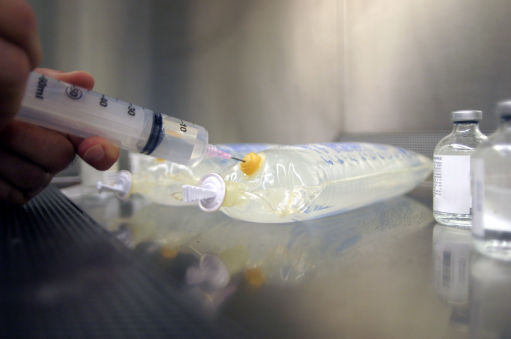
The Market pathway also has a clear role. Where licensed ready-to-administer or ready-to-use medicines are available, they can support standardisation, productivity and patient safety.
Then there is the Mix pathway.
The Mix pathway is about partnership and collaboration.
It brings together Trusts, compounders, manufacturers, specialist wholesalers such as OPS and logistics providers to create a more flexible model of supply. It is especially relevant where medicines can be batch-prepared, stocked and supplied off the shelf, rather than doses being prepared locally or ordered as a patient-specific item.
That’s exactly where the Mix pathway works well, local teams can focus their specialist capacity on the work that genuinely needs to stay local.
Mix isn’t about replacing local aseptic services. It is about assisting & protecting them.
OPS and the off-the-shelf stores model
OPS’s off-the-shelf stores model has been developed to support the rapidly growing aseptic supply demand.
“At OPS, the objective of the stores model is to support patient care by helping reduce cancelled or delayed treatments, providing a reliable emergency supply route during unplanned aseptic unit closures, and supporting Trusts where off-the-shelf models are required. The model is also built around continuous improvement, with regular customer engagement, feedback, review meetings and service performance monitoring helping to shape how the service develops.”
In practical terms, resilience becomes more than a concept. It becomes stock availability, lead time, forecasting, communication, delivery performance and OTIF: on time, in full.
The Stores model offers no minimum order quantity, order consolidation, access to batch pricing, short lead times, next-day delivery and support for outsourcing where appropriate.
By holding selected batched products as stock, OPS helps reduce reliance on every order being manufactured against immediate demand. This supports Trusts that need reliable access, while also helping compounders plan production more effectively.
Through this approach, OPS demonstrates the practical value of the off-the-shelf model at Trust level – including improved access, reduced waste, better use of local aseptic capacity and measurable operational benefits.
Evidence from practice
A recent case study from Royal Berkshire shows what this looks like in practice.
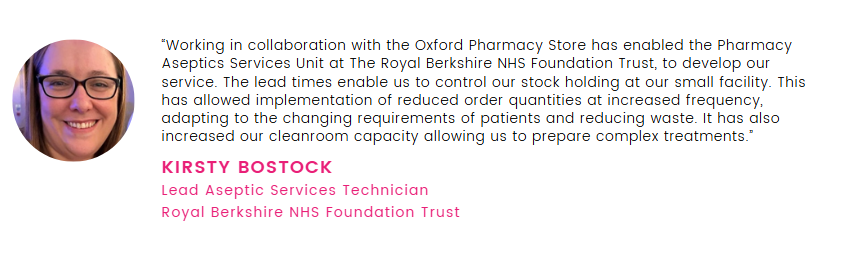
Royal Berkshire, like many other Trusts, has very limited storage and refrigerator space. Their partnership with OPS reported a significant reduction in average lead times to 1.5 days and supported the trust to free up capacity for preparation of the products that require compounding locally.
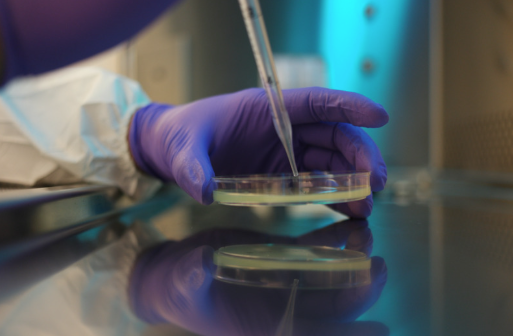
Their case study highlights reduced waste, reduced “just in case” stockholding, access to batch pricing, reduced cancelled or delayed treatment, better use of limited storage and refrigerator space, and increased cleanroom capacity for complex treatments. This is a clear example of how an off-the-shelf model can provide emergency support during unplanned unit closures or reduced capacity, while continuing to protect supply for regular customers. For Trusts under pressure, that kind of flexibility can be a lifeline.
The Bath ASU and OPS partnership demonstrates how stockholding can smoothly peaks and troughs in demand, allowing manufacturing to be performed in a steadier and more optimised way. This improves accessibility and assurance of supply across the extended pathway.
Why NHS ownership matters: next steps for a shared supply model
OPS is an NHS-owned specialist pharmaceutical wholesaler. That matters in this context.
OPS supplied an average of 15,551 lines in last 12 months across 46 different NHS sites. Products supplied through the model include oncology and monoclonal antibody lines such as atezolizumab, bevacizumab, bortezomib, carboplatin, daratumumab, nivolumab, oxaliplatin, pembrolizumab and vincristine, with additional products considered as demand and availability evolve.
At Oxford Pharmacy Store we operate within the NHS ecosystem and understand the pressures facing Trusts, pharmacy teams, procurement leads and aseptic services. OPS surplus profits are reinvested back into the NHS, supporting patient care, research and development, and wider NHS benefits.
OPS’s aseptic strategy describes the goal clearly: to provide a high-quality off-the-shelf supply model for aseptically prepared products, ensuring timely and reliable access to essential medicines, particularly during service disruption, capacity constraints and aseptic unit shutdowns.
The future of aseptic medicines will depend on getting the pathway right.
- Make – where local expertise and responsiveness are essential.
- Market – where licensed ready-to-administer options are suitable.
- Mix – where off-the-shelf, batch-prepared and partnered supply can improve access, reduce avoidable pressure and strengthen resilience.
OPS proudly sits in that practical middle ground.
Through our off-the-shelf stores model, manufacturer and compounder partnerships, OTIF focus, short lead times and NHS-owned purpose, we at OPS support and represent the Mix pathway across secondary care.
Therefore, the future will not be one route. It will be the right route, and will be used well, with patient care at the center.
Sources:
• ***Sue Ladds, CPC 2026: Make, Market or Mix – Crafting the NHS Injectables Model of the Future. Used for national context, injectable medicines expenditure, productivity ambitions, workforce and operating model themes.
• OPS Stores Model Case Study. Used for stores model benefits, Royal Berkshire lead-time evidence, Bath ASU collaboration, next-day delivery, no minimum order quantity and batch-pricing points.
• Oxford Pharmacy Store Aseptic Service Strategy 26/27. Used for OPS positioning, shutdown and contingency support, off-the-shelf service objectives, OTIF focus, stakeholder engagement and NHS-owned resilience positioning.
You must be logged in to view this page.